Irregular cornea
An irregular corneal surface can distort vision in ways that ordinary spectacles or soft lenses do not fully correct.
On this page
What is Irregular cornea?
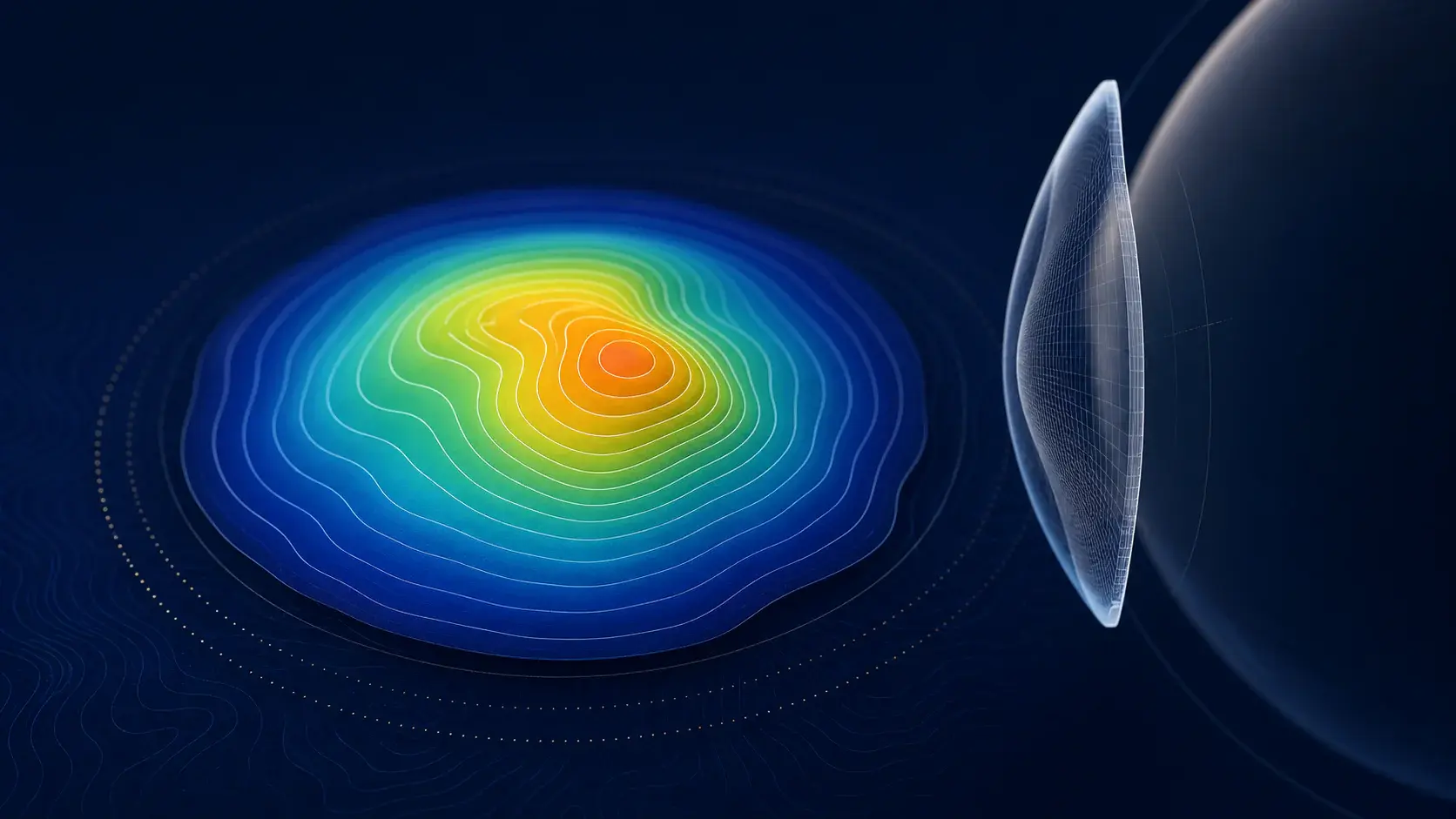
The cornea is the clear front surface of the eye and provides much of its focusing power. When its shape or surface is irregular, light may not focus to a single clear point. Irregularity can have several causes and is a description, not a diagnosis by itself.
A careful clinical boundary
A specialist lens can create a more regular optical surface, but it does not treat every underlying cause of corneal irregularity. Diagnosis and medical or surgical management may require an ophthalmologist.
- Blur, ghosting or overlapping images
- Glare, starbursts or halos around lights
- Fluctuating vision or reduced contrast
- A prescription that does not provide the expected clarity
- Difficulty finding a comfortable, stable contact-lens fit
- Similar visual experiences can arise from different parts of the eye.
- A careful history and corneal assessment can help locate the source of the irregular focusing.
- The cause, stability and previous surgery influence whether correction, monitoring or referral is appropriate.
What may be considered.
- 01
When the visual change began and whether it is stable
- 02
Current spectacles, lenses and previous prescriptions
- 03
Previous corneal or refractive surgery, injury or disease
- 04
Refraction, ocular surface and eye health
- 05
Corneal-shape measurement where relevant
- 06
Visual response to a diagnostic rigid or specialist lens where appropriate
The next step depends on what the assessment finds.
Identify the visual needThe first step is to understand whether the main difficulty is blur, distortion, comfort, fluctuation or a combination. That goal helps guide which measurements and trial correction are useful.Read the explanation
Blur, distortion, fluctuating vision and discomfort can have different causes. Understanding when the problem occurs and which tasks are affected helps the clinician choose useful measurements and trial correction.
The first option discussed may not be the final one. A diagnostic fitting or further assessment may be needed before the likely benefits and limitations are clear.
Explore optical correction
Depending on the cause and degree of irregularity, options may include spectacles, a custom soft lens, a corneal RGP lens or a scleral lens. Availability and suitability must be confirmed individually.Learn about diagnostic lens fittingCoordinate care
If findings suggest active disease, a surgical issue or another medical concern, referral to or communication with an ophthalmologist may form part of the plan.Learn about coordinated careFrequently asked questions
These answers are general. An individual assessment is needed for advice about your own eyes, prescription or lenses.
Is an irregular cornea the same as keratoconus?
No. Keratoconus is one possible cause. Irregularity can also follow surgery, injury, scarring or another corneal condition.
Why might spectacles be less effective?
Spectacles can correct regular focusing errors well. They may not neutralise all of the optical distortion created by an uneven corneal surface.
Does everyone need a hard lens?
No. The most suitable correction depends on the cause, shape, eye health, visual goal and response during assessment.
Explore clearer correction
Contact the practice or ask a non-urgent question if you have been told that your cornea is irregular.